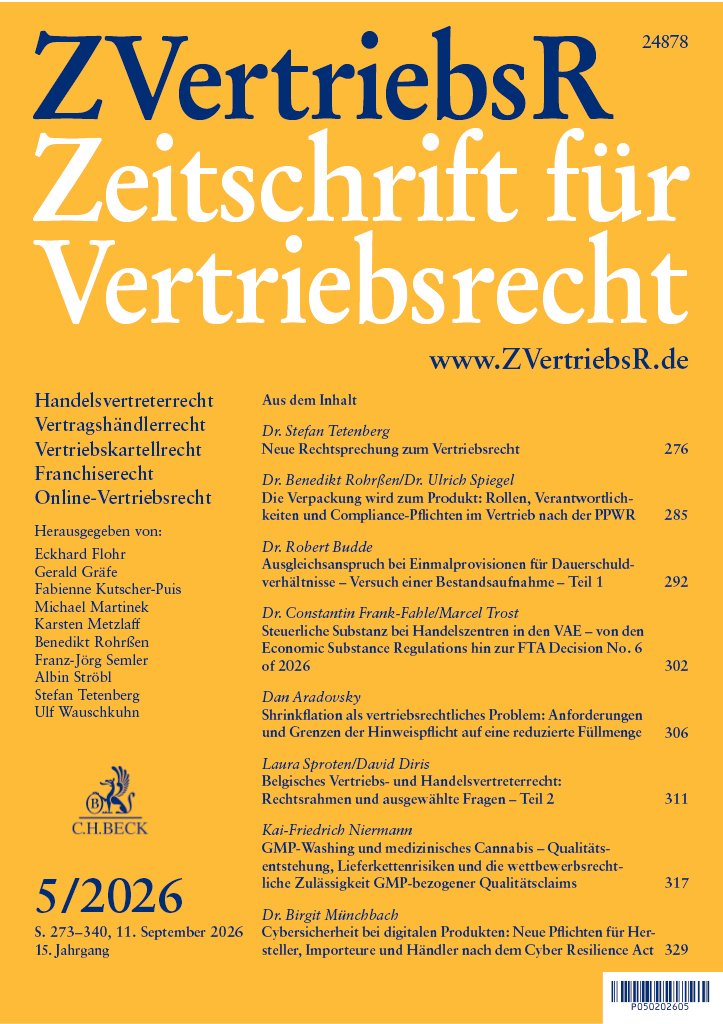
Published articles

Our technical articles are mainly available in German.

Country Report Kenya

So far in 2026, Kenya has been characterized by exceptionally high reform momentum. With comprehensive changes to the tax, financial market, technology, labor, and corporate laws, as well as numerous other regulatory initiatives, the government has further developed the economic regulatory framework to an extent not seen in years. At the same time, the political environment remained characterized by persistent tensions between the executive and judiciary, as well as recurring social protests.

Substance instead of appearance: The real employer in the Employer of Record model

So-called Employer of Record models (EoR models) promise companies solutions for the international expansion of business activities and the increasingly challenging search for qualified professionals. The EoR model is an employment model originally originating from the Anglo-American region that aims to facilitate the employment of workers abroad by an agency (the EoR) hiring workers at the point of deployment based on an employment contract in accordance with local law and transferring the employer’s authority to direct the work to the client company. The work is then performed in full or in part in the respective deployment country under the supervision of the client company. However, what many companies consider to be an extremely practical solution is associated with certain risks, which arise in particular from German and foreign labor and residence laws as well as from social security and tax law. Due to the risk of abuse, EoR models may come under scrutiny by (foreign) labor, immigration, and tax authorities as well as social security institutions. The present paper presents the EoR model, explains selected risks, provides the basics and testing criteria for the substance test, and provides insights into the regulatory and fiscal dimensions of substance test failures. The paper concludes with an overview of practical strategies for strengthening compliance and a look ahead.

The Dimensions of Economic Substance

Economic substance has various dimensions in the United Arab Emirates (“UAE”). At the domestic level, it manifests mainly under the Qualifying Free Zone Person (“QFZP”) concept, whereby businesses may claim a special 0 per cent Corporate Tax (“CT”) rate under certain conditions, rather than the standard 9 per cent. One of the conditions that QFZPs need to fulfil is to “maintain adequate substance”, failing which the benefit is lost for at least 5 years.

Temporary presence on-site – permanent risk? Pitfalls in the deployment of German construction companies abroad

Temporary foreign assignments of own employees for the assembly and commissioning of systems are common practice in the international project business of German plant construction companies. However, if no local subsidiary exists and the necessary investment permits as well as the mandatory residence and work permits have not been applied for, legal and tax consequences threaten. This article examines the various pitfalls for German plant builders with international business.

Between war and peace: German companies and investors in the Gulf states six months after the outbreak of the Iran conflict

The Iran conflict between the US and Israel on the one hand and Iran on the other, which broke out on February 28, 2026, has now been ongoing for six months. Although the Gulf states are not parties to the conflict themselves, they have repeatedly been the target of military attacks by Iran since February 28, 2026. After military clashes initially came to a halt following the entry into force of a ceasefire in early April 2026, there was initially hope that the Gulf region would be able to return to its accustomed stability relatively quickly. However, renewed attacks by Iran on individual Gulf states during the ceasefire phase quickly demonstrated the fragility of the ceasefire. On June 18, 2026, the US and Iran signed a Memorandum of Understanding in which both parties committed, among other things, to the immediate and permanent cessation of military operations. The framework agreement expired 60 days after its signing, specifically in August 2026. As a result of these developments, the Gulf region finds itself in a situation between war and peace six months after the outbreak of the conflict. Daily life in the Gulf states continues as usual, and businesses and investors in the Gulf states are pursuing their business activities as per usual, but have also been facing new challenges since the outbreak of the conflict, which they must address with adaptation strategies.

Tax substance in trade centers in the UAE – from the Economic Substance Regulations to FTA Decision No. 6 of 2026

The United Arab Emirates (UAE) has established itself as a trade hub between Europe, Africa and Asia. Trade centers that operate the export and re-export of goods from the free trade zones of the UAE initially adhered to the substance requirements of the so-called Economic Substance Regulations. These have been temporarily abolished; the substance requirements are now fully covered by the corporate tax regime. With Federal Tax Authority Decision No. 6 of 2026, the UAE federal tax authority has for the first time set out in detail how trade centers in so-called Designated Zones must demonstrate the requirements for their tax privileges. The article explains the new requirements and places them in the context of the development of substance requirements in the UAE.

How much substance in the United Arab Emirates is enough? – Clarifications on the substance requirement for Qualifying Free Zone Persons

The United Arab Emirates (UAE) has repealed the Economic Substance Regulations, which were introduced in 2019, for fiscal years ending after December 31, 2022. However, the economic substance requirement remains in effect: Companies in free trade zones that wish to benefit from the preferential corporate income tax rate of 0 % as a „Qualifying Free Zone Person“ must maintain adequate substance in the respective free trade zone. Until now, the law and implementing regulations have left largely open what exactly constitutes “adequate substance.” With the publication of the “Corporate Tax – Summary of FTA Private Clarifications Issued Up to May 2026,” the Federal Tax Authority has now provided a comprehensive overview of its current administrative practice regarding the substance requirement. This article analyzes the clarifications in the section “Free Zones – Adequate Substance” in detail and contextualizes them within the framework of UAE corporate tax law and in light of German tax on foreign income.

The negative declaratory action as a procedural strategy in third-country traffic – lis pendens, service of process, and enforcement outside the EU

As a result of globalization, cross-border business relationships are part of everyday business for many German companies. While intra-European legal transactions are largely harmonized by the Brussels Ia Regulation (Brussels Ia Recast) as well as supplementary conventions, the procedural enforcement of claims against contractual partners based in third countries can still pose significant challenges for companies and their legal advisors. In particular, when no multi- or bilateral agreements on the mutual recognition and enforcement of court judgments exist, complex issues regularly arise regarding the choice of the correct jurisdiction, the lis pendens of parallel proceedings, and the enforceability of any resulting titles. Early consideration of these issues is not only essential for successfully enforcing one's own claims, but also for protection against potentially costly and protracted litigation abroad.

Negotiation strategies in the Arab Gulf states – Between a sense of fairness and the logic of leverage?

Over the past decades, the Arab Gulf states, including Saudi Arabia, the United Arab Emirates (UAE), Qatar, Kuwait, Oman, and Bahrain, have developed into attractive markets for European companies. Although the degree of business involvement in practice often varies—ranging from establishing a local business presence to concluding individual supply contracts or service agreements—business engagement in the region regularly requires successful negotiation. Inexperienced negotiators lacking an awareness of cultural differences and local peculiarities frequently encounter limitations during negotiations. The following article provides an overview of selected aspects of negotiation in the Arab Gulf states and also explains some typical pitfalls that European companies may encounter during negotiations in the region.

Our newsletter

Stay informed.

Simply enter your e-mail address in the adjacent form and click on "Subscribe".

Your name

By subscribing to our newsletter, you agree to receive emails from emltc. Please read our privacy policy to find out more about how we protect your data.

Singapore

emltc Pte. Ltd. Singapore
1 Wallich Street, #14-01, Guoco Tower
Singapore 078881

Mombasa

Emerging Markets Corporate Services LLP
Mombasa Trade Center
2nd Floor, North Tower
P.O. Box 87802-80100
Mombasa, Kenya

Nairobi

Emerging Markets Corporate Services LLP
Duplex Apartments, Suite No. 61
Lower Hill Road, Upper Hill
P.O. Box 30315-00100
Nairobi, Kenya

Addis Ababa

emltc Ethiopia
(in cooperation with Hailye Sahle)
Dembel Building
Office No. 1107/A, Bole Subcity, Kebele 20/21
Addis Ababa, Ethiopia

Erbil

emltc Kurdistan Region of Iraq
Office 501, 5th Floor
Sayid Tayyib Building
Ronaky Q.
Erbil, Iraq

Kuwait

emltc Kuwait City
(in corporation with DMLC)
Jabriya Block 10
Abdullah Dashti Street
Kuwait City, Kuwait

Riyadh

emltc KSA
(in cooperation with Fahad Gasim & Mohammad Alyousef Law Firm)
Olaya St., Siricon Building 14
Riyadh, Kingdom of Saudi Arabia

Karachi

emltc Pakistan LLP
Office No. 415, 4th Floor
Cotton Exchange Building I.I. Chundrigar Road
Karachi, Sindh, Pakistan

Lahore

emltc Pakistan LLP
7-A, 3rd Floor, Kapurthala House
Lake Road
Old Anarkali
Lahore, Pakistan

Dhaka

emltc Bangladesh Limited
Office No-305 (2nd floor), 3/B, Purana Paltan, Shabag
Dhaka-1000, Bangladesh

Dubai

emltc FZCO
2804, Jumeirah Business Center 3
Cluster Y, Jumeirah Lake Towers
Dubai, United Arab Emirates

Abu Dhabi

emltc Ltd.
Office no. 113, 1st Floor, Pixel Plaza
Tower 6, The Makers District
Abu Dhabi, Al Reem Island, United Arab Emirates