Published articles

Our technical articles are mainly available in German.

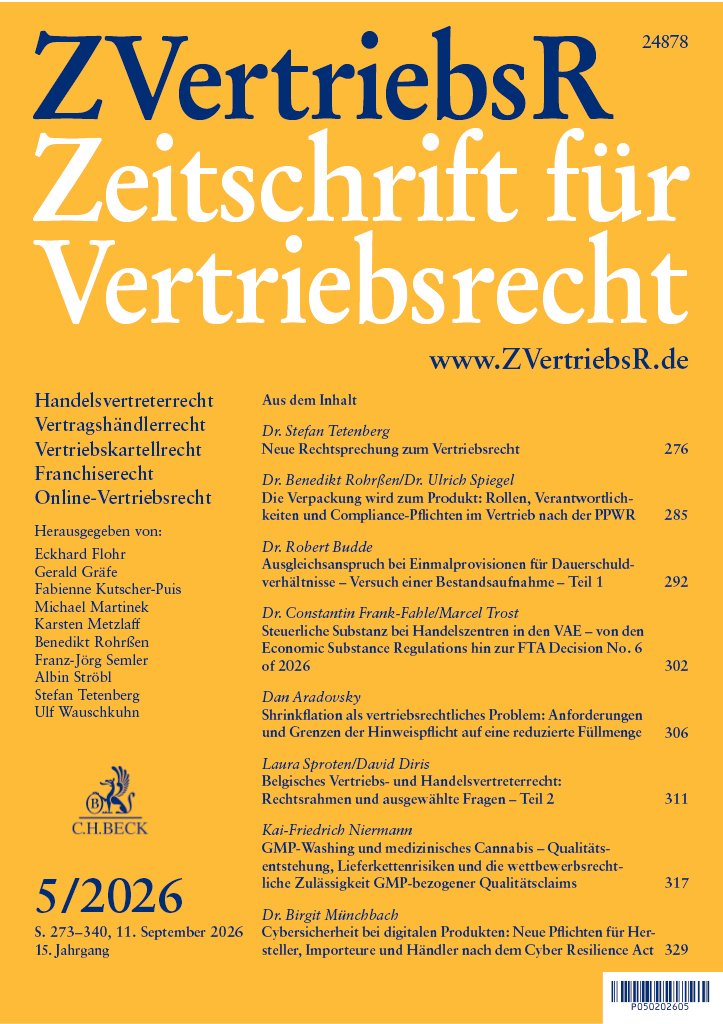
Tax substance in trade centers in the UAE – from the Economic Substance Regulations to FTA Decision No. 6 of 2026

The United Arab Emirates (UAE) has established itself as a trade hub between Europe, Africa and Asia. Trade centers that operate the export and re-export of goods from the free trade zones of the UAE initially adhered to the substance requirements of the so-called Economic Substance Regulations. These have been temporarily abolished; the substance requirements are now fully covered by the corporate tax regime. With Federal Tax Authority Decision No. 6 of 2026, the UAE federal tax authority has for the first time set out in detail how trade centers in so-called Designated Zones must demonstrate the requirements for their tax privileges. The article explains the new requirements and places them in the context of the development of substance requirements in the UAE.
The tension between localization and free trade – On the free trade agreement between the EU and the UAE in light of national in-country value programs

The architecture of international trade law is currently facing profound challenges. While the multilateral trading system under the auspices of the World Trade Organization (WTO) has been geared toward progressive liberalization and the reduction of discriminatory trade barriers for decades, a global renaissance of protectionist tendencies, inter alia through industrial policy instruments, can be observed. This development manifests not exclusively in the reintroduction of comprehensive tariffs, but also in more subtle instruments with market-steering effects: localization requirements (so-called local content requirements – LCR), national preference rules in public procurement, and strategic industrial subsidy programs are increasingly shaping the trade landscape. This paper examines the structural tension between the liberal objectives of a free trade agreement and the protectionist effects of industrial policy localization instruments using the specific example of the planned free trade agreement between the EU and the UAE as well as the UAE's In-Country Value program.

Supply Chains Under Fire: Sales Law Risks and Strategies in the 2026 Iran War

Since February 28, 2026, the Arab Gulf states have become targets of military attacks by neighboring Iran. Although the Gulf states are not directly involved in the war with Iran, they have repeatedly been targets of Iranian attacks since the beginning of the military conflict, with the intensity and scope of these attacks varying significantly among individual states. As a result of the attacks, the airspace of the United Arab Emirates („UAE"), Qatar, Bahrain, and Kuwait was initially closed. This quickly led to disruptions in regional and international air traffic, as Dubai International Airport and Hamad International Airport in Doha, in particular, are extremely important logistics hubs for international passenger and freight traffic. Shortly after the outbreak of the conflict, the Strait of Hormuz was also effectively closed. Consequently, global energy supply has been significantly impacted, and international supply chains have been interrupted or sustainably disrupted, resulting in increased commodity prices. Furthermore, a worldwide increase in end-consumer prices is to be expected. Against this background, the question arises as to how military actions and their economic consequences – particularly the unavailability of products, transport delays, and price increases – affect existing distribution agreements and what rights affected companies have in this regard.

The provision of personnel to commercial agents and distributors using the example of the Gulf Cooperation Council states

German companies often use commercial agents or distributors (sales dealers) to tap into the attractive sales markets of the GCC states. If these are to be supported locally by the (temporary) provision of personnel by the German company, there are various legal and tax risks, some of which are outlined below.

Setting up regional distribution centers in Thailand - investment law hurdles and tax incentives

In addition to the previously preferred investment target regions in Asia (China, Japan, South Korea and India), European investors are increasingly focusing on the countries of the Association of Southeast Asian Nations (ASEAN). The ten ASEAN states, which represent an important association in Asia with around 630 million people, include Thailand, Indonesia, Malaysia, the Philippines and Vietnam, all of which are significant individual economies.

Our newsletter

Stay informed.

Simply enter your e-mail address in the adjacent form and click on "Subscribe".

Your name

By subscribing to our newsletter, you agree to receive emails from emltc. Please read our privacy policy to find out more about how we protect your data.

Singapore

emltc Pte. Ltd. Singapore
1 Wallich Street, #14-01, Guoco Tower
Singapore 078881

Mombasa

Emerging Markets Corporate Services LLP
Mombasa Trade Center
2nd Floor, North Tower
P.O. Box 87802-80100
Mombasa, Kenya

Nairobi

Emerging Markets Corporate Services LLP
Duplex Apartments, Suite No. 61
Lower Hill Road, Upper Hill
P.O. Box 30315-00100
Nairobi, Kenya

Addis Ababa

emltc Ethiopia
(in cooperation with Hailye Sahle)
Dembel Building
Office No. 1107/A, Bole Subcity, Kebele 20/21
Addis Ababa, Ethiopia

Erbil

emltc Kurdistan Region of Iraq
Office 501, 5th Floor
Sayid Tayyib Building
Ronaky Q.
Erbil, Iraq

Kuwait

emltc Kuwait City
(in corporation with DMLC)
Jabriya Block 10
Abdullah Dashti Street
Kuwait City, Kuwait

Riyadh

emltc KSA
(in cooperation with Fahad Gasim & Mohammad Alyousef Law Firm)
Olaya St., Siricon Building 14
Riyadh, Kingdom of Saudi Arabia

Karachi

emltc Pakistan LLP
Office No. 415, 4th Floor
Cotton Exchange Building I.I. Chundrigar Road
Karachi, Sindh, Pakistan

Lahore

emltc Pakistan LLP
7-A, 3rd Floor, Kapurthala House
Lake Road
Old Anarkali
Lahore, Pakistan

Dhaka

emltc Bangladesh Limited
Office No-305 (2nd floor), 3/B, Purana Paltan, Shabag
Dhaka-1000, Bangladesh

Dubai

emltc FZCO
2804, Jumeirah Business Center 3
Cluster Y, Jumeirah Lake Towers
Dubai, United Arab Emirates

Abu Dhabi

emltc Ltd.
Office no. 113, 1st Floor, Pixel Plaza
Tower 6, The Makers District
Abu Dhabi, Al Reem Island, United Arab Emirates